Strawberry Roses Baby the Stars Shine Bright 2016
Japanese street manner refers to a number of styles of contemporary modern clothing in Japan. Created from a mix of both local and foreign fashion brands, Japanese street fashions tend to accept their own distinctive manner, with some considered to exist extreme and avant-garde, with similarities to the haute couture styles seen on European catwalks.
Though extremely pop in the 1990s and early 2000s, many trends experienced a levelling off in the after 2000s and onwards; the rise and autumn of many of these trends had been chronicled past Shoichi Aoki since 1997 in the style mag Fruits, which was a notable magazine for the promotion of street mode in Japan.[ane]
History [edit]
In 2003, Japanese hip-hop, which had long been present among secret Tokyo's club scene, influenced the mainstream style manufacture.[ii] The popularity of the music was so influential that Tokyo'southward youth imitated their favorite hip hop stars from the way they dress with oversized clothes to tanned skin.[3]
Mod Japanese street fashion [edit]
Though the styles take changed over the years, street style is still prominent in Tokyo today. Immature adults can oft be plant wearing subculture attire in large urban style districts such every bit Harajuku (Ura-Harajuku), Aoyama, Ginza, Odaiba, Shinjuku and Shibuya.
Lolita [edit]
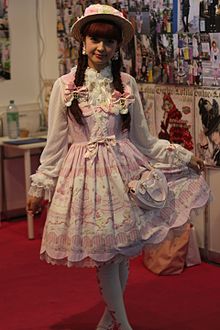
Containing many dissimilar themes inside its boundaries, Lolita has get one of the larger, more than recognizable styles in Japanese street mode and has gained a post-obit worldwide. Skirts or dresses are ordinarily worn at or below knee length with petticoats below for volume. Blouses or tops are lace-trimmed or ruffled in the Victorian or Rococo style. The length of the socks or stockings can become from ankle to thigh level and may be topped with lace. Wearers of this manner style often put on Mary Janes or boots. The more well-known sub-styles within Lolita fashion are as follows:
- Gothic Lolita - Lolita with a heavy influence from the Eastern and Victorian Goth style. Often characterized by dark colors, and accessories adorned with motifs such as skeletons, bats, spiders and other popular gothic 'icons', such as characters from Tim Burton films. Victorian atomic number 26 gates and architectural designs are also often seen in wearing apparel prints. Bonnets, rectangle headdresses and brooches are popular accessories for Gothic Lolita.
- Sweetness Lolita - the well-nigh childlike style, more often than not characterized by baby animals, fairy tale themes and innocent, artless attire. Information technology was originally inspired by Victorian children's clothing and the kawaii civilisation that is very prevalent in Nippon. Pastel colors are often used, although some dresses or skirts may feature darker or muted colors as well. Big head bows, beautiful purses and stuffed animals are popular accessories for Sweet Lolita.
- Classic Lolita - a sub-fashion more closely resembling the historical fashion of the Rococo or Victorian eras. The colors that are used in this await are usually muted, thus giving this sub-style a more mature feel. Floral prints and solid colors are common, although fancier prints are not unheard of as well. Pocket-size head bows, bonnets, rectangle headdresses and hair corsages are popular accessories for Archetype Lolita.
- Punk Lolita - an experimental style, mixing the influences of Punk with Lolita. It can sometimes look deconstructed or crazy, while keeping most of the 'Lolita silhouette'.
- Ouji - also known equally 'male child fashion', are the more than masculine counterparts of lolita, influenced by Victorian boys' wear. 'Prince pants', which are short capri-way pants that are cutting off the human knee, usually with some sort of detail (such every bit lace-edged cuffs) are usually worn with masculine blouses, top hats, knee joint socks and other accessories.[4]
Gyaru [edit]
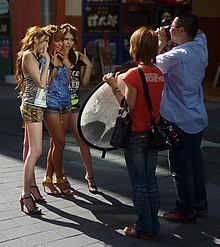
Gyaru being photographed in Ikebukuro in 2009
Gyaru (sometimes known as Ganguro , actually a subcategory of gyaru ), is a type of Japanese street fashion that originated in the 1970s. Gyaru focuses on girly-glam style, dwelling on human-fabricated beauty, such equally wigs, simulated lashes and fake nails. Gyaru is too heavily inspired by Western fashion.
Ganguro [edit]
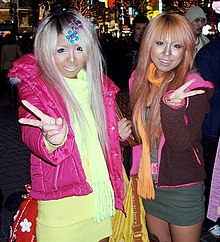
Two ganguro girls in Tokyo, April 2008
The Ganguro way of Japanese street fashion became popular amidst Japanese girls in the early 1990s and peaked in the early 2000s. Ganguro falls into the larger subculture of gyaru fashion. Ganguro typically includes brightly colored outfits, mini-skirts, and tie-dyed sarongs. The ganguro mode consists of bleached pilus, a deep tan, fake eyelashes, black and white eyeliner, bracelets, earrings, rings, necklaces and platform shoes.
Many people consider Namie Amuro to accept been the leading effigy of ganguro fashion. Exactly after her public appearances with tanned skin and dyed hair, a lot of Japanese girls started to follow her instance. The terms "Yamanba" and "Manba" refer to the farthermost ends of the Ganguro mode. Nonetheless, enthusiasts of both the Yamanba and Manba styles consider ganguro as an "easy version" of their way. Present, the name 'Yamanba' has shortened to 'Manba' . [v]
Kogal [edit]
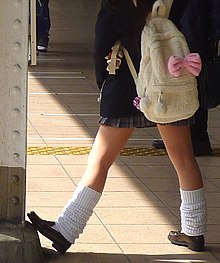
A kogal identified by her loose socks and shortened skirt
The Kogal ( Kogyaru ) wait is based on a high school uniform, simply with a shorter skirt, loose socks, and often dyed pilus and a scarf as well. Members of the Kogal style sometimes refer to themselves as Gyaru (gals). This manner was prominent in the 1990s, and it started gaining its popularity again since the end of 2020.
Bōsōzoku [edit]
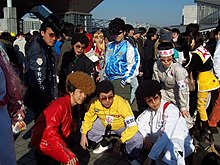
Japanese cosplayers dressed up in bōsōzoku -style outfits
While bōsōzoku fashion has non been widely popular since the 1990s, the stereotypical Bōsōzoku look is often portrayed, and fifty-fifty caricatured, in many forms of Japanese media such every bit anime, manga and films. The typical bōsōzoku member is often depicted in a uniform consisting of a one-piece similar those worn by manual laborers or a tokko-fuku ( 特攻服 ), a type of military issued over-coat with kanji slogans. These are unremarkably worn open, with no shirt underneath, showing off bandaged torsos and matching amorphous pants tucked inside tall boots.
Decora [edit]
The Decora manner originated in the late 1990s/early 2000s and rose to great popularity both in and outside Japan. Information technology is exemplified by vocalizer Kyary Pamyu Pamyu, who rose to prominence in the Harajuku mode scene earlier her musical debut. The wearers usually stick to color palettes for their decora, examples including Pink Decora, Cherry-red Decora, Dark Decora, and Rainbow Decora. A plain shirt and hoodie were oftentimes worn with short tutu-similar skirts. The hair (often worn in low ponytails with long bangs) and make-up itself tend to be quite obviously. However, the most significant part of Decora is to pile on many layers of cute accessories until the bangs and front end hair are barely visible. Stockings, legwarmers, arm warmers, and knee socks are also worn over each other in dissimilar layers. Common details also include leopard prints and patterned dental masks. The style has since decreased in popularity but all the same has a large following worldwide.
Visual Kei [edit]

Visual Kei is a style created in the mid-1980s by Japanese musicians consisting of striking makeup, unusual hair styles and flamboyant costumes, like to Western glam stone and glam metal. Androgyny is also a popular attribute of the manner. Some of the more well-known and influential artists of the mode include 10 Nihon, Luna Sea, Versailles, The Gazette, Mejibray, Royz, Fifty'Arc en Ciel, An Cafe, Malice Mizer, and Diaura.
[edit]
Oshare Kei is the reverse side of Visual Kei , with bright colors and many popular impressions. This said, bands under this style live upwards to the significant by dressing upward in colorful costumes, or in Decora or Pop Kei style; many are seen sporting large amounts of jewelry and bags of cartoon characters and animals slung on, many colorful hairclips, and lighter make-up. The music is more than happy sounding, the lyrics lighter and happier. Bands include An Cafe, Panic Aqueduct, Ichigo69, Lolita23q, SuG, Delacroix, LM.C, and Aicle.[six]
Angura Kei [edit]
Angura Kei is a dark Japanese fashion that is often associated with a subgenre of Visual Kei . The term derives from the Japanese pronunciation of "underground", which refers to its origins in underground theater. The dress tend to be heavily influenced by traditional Japanese elements as well equally the Showa era (1926-1989) merely with a Goth spin to it. The make-upwardly usually consists of shironuri , and is dark and heavy. While kimono are the near common used by visual kei artist, the style also often features modified japanese school uniforms. Motifs and accessories are themed around post-war Japan and the occult.
Cult Party Kei [edit]
Cult Party Kei , named subsequently the Harajuku store Cult Party (now known as the Virgin Mary), is a style that was pop around the early 2010s and is based on Western religious artifacts like crosses or bibles. Mutual aspects include crosses wired in yarn, layers of fabric in soft colors, lots of cream lace, satin bows and bible prints. The brand-up and hairstyle is not every bit over the top as other styles. Cult Political party Kei is often worn with natural looking make-up without any larger emphasis on the eyes and unproblematic hair-dos with roses. Cult Party Kei is considered by some to be a subset of Dolly Kei .
Dolly Kei [edit]
Dolly Kei is a fashion based on Japan's view of the Middle Ages and European fairy tales, especially the Brothers Grimm and Hans Christian Andersen. Information technology includes a lot of vintage-manner clothing and sometimes has religious symbols. Grimoire is a store in Japan that has been described as "the pioneering shop behind the Dolly- kei fashion scene".[vii]
Fairy Kei [edit]
Fairy Kei is a childlike manner based on 1980s fashion. Outfits are made up of pastel colors, angels, toys and generally cute motifs and elements and accessories from Western toy lines of the 1980s and early 1990s, such as Polly Pocket, My Petty Pony, Strawberry Shortcake, Rainbow Brite, Popples, Lady Lovely Locks, Barbie, Wuzzles, and Intendance Bears. Pastel-colored pilus is common, although natural hair is also pop, and hairstyles are ordinarily kept uncomplicated and decorated with anything cute or pastel; bows are a common theme. The term "Fairy Kei " originated from the magazine called Zipper (despite common belief that Sayuri Tabuchi [Tavuchi], the possessor of Tokyo mode store Spank!, was the accidental creator of the style).[8]
Mori Kei [edit]
Mori Kei ( mori meaning "forest") uses soft, loosely plumbing fixtures layers of garments such every bit floaty dresses and cardigans. It places an accent on natural fabrics (cotton, linen, wool) and hand-made or vintage accessories with a nature theme. The color scheme tends to be light and neutral, but patterns such every bit gingham and florals may likewise be used. In terms of hairstyles, bangs (often curled) and braids are very pop. The way is similar to Dolly Kei in that the aim is to create a doll-like advent, simply in a more than casual, earthy way.[nine]
Peeps [edit]
Peeps is a 90s inspired sporty goth manner that has been popularized in Harajuku's cloak-and-dagger scene past the online magazine PEEPS. It was voted one of the major trends for 2020 in the yearly tendency forecast past the japanese women's magazine Mery.[x]
Kimono Way [edit]
Despite the widespread nature of Western clothing in Japan, Japanese fashion is still influenced by traditional clothing, with people still wearing the kimono in daily life, though almost people wear information technology merely for weddings, graduations and other formal occasions.
Despite the heavily-reduced numbers of people wearing kimono as everyday clothing, the younger generation in Japan tin can still exist seen to mix kimono and modern style in fashion, wearing modern footwear and accessories instead of the typical geta and kanzashi usually worn. In that location are fifty-fifty modern designers who take used the kimono as inspiration, such as the "TANZEN" drove from designer Issey Miyake.[ citation needed ]
Style industry and popular brands [edit]

Although Japanese street fashion is known for its mix-lucifer of different styles and genres, and in that location is no single sought-afterward brand that can consistently appeal to all fashion groups, the huge demand created by the style-conscious population is fed and supported past Nihon's vibrant fashion manufacture. Issey Miyake, Yohji Yamamoto and Comme des Garçons are often said to be the three cornerstone brands of Japanese fashion. Together they were particularly recognized equally a Japanese way force in the early on 1980s for their intensive utilize of monochrome color and cutting-edge design.
As early as the 1950s, at that place were a few brands particularly catered to street way, such equally Onitsuka Tiger (now known equally the ASICS).
Japan is also known for its pregnant consumption of foreign luxury brands. Co-ordinate to data from 2006, Japan consumed 41 per centum of the unabridged world's luxury goods.[11] The blue line of Burberry is among the most successful in this arena.
International influence [edit]
Japanese street fashion influences the West Declension of the United states of america.[12] High-end way brands like Comme des Garçons have played a big role in the global industry since the 1980s, peculiarly through frequent cross-over invitee design with other brands. In 2008, Rei Kawakubo designed for Louis Vuitton[xiii] and H&M.[14]
Tomoko Yamanaka's work was featured at London Fashion Week, 2010.[15]
Harajuku Fashion was ranked 5th in the fashion field of Google Search of the Year in 2019.[16]
[edit]
The social motives driving interaction with and involvement in personal way choices and wider mode movements within Nippon are complex.
Firstly, the insufficiently big quantity of disposable income available to Japanese youth is significant; many argue this has been, historically, fabricated possible through a greater degree of Japanese youth living at home with their parents for much longer than in other countries, reducing living expenses and thus making larger spending on clothing possible.[17]
In add-on, the emergence of strong youth civilization in the 1960s and 1970s that continues today (especially in Harajuku, a district in Shibuya, Tokyo, Japan.) drives much of the development of new styles, looks, and fashion subcultures. The rise of consumerism, which played an important role in Japan's "national character" during its economical boom in the 1980s, continues to influence fashion purchases, even after this economic bubble flare-up in the 1990s. These factors result in the swift turnover and variability in styles popular at any one time.[18]
Encounter also [edit]
- 2000s in Japanese fashion
- 2010s in Asian way
- Youth culture
- Camp (way)
- Fruits (mag)
- Cuteness in Japanese civilisation
- Madam/Aristocrat
- Elegant Gothic Blueblood
- Neo-Victorian
- Cosplay
- Visual Kei
- Poupee Girl
- Babe the stars shine bright
References [edit]
- ^ "Fruits: futurity-pop fashion". Dazed. 2016-01-12. Retrieved 2019-07-28 .
- ^ Takatsuki, Yo (2003-12-17). "Japan grows its ain hip-hop". BBC News.
- ^ Condry, Ian. Hip-hop Japan: Rap and the Paths of Cultural Globalization. Durham, NC: Duke University Press, 2006.
- ^ "Kodona". Archived from the original on 2012-03-17.
- ^ DIGIMBAYEVA, ANELIYA (August 3, 2018). "Japanese Street Manner". STREETWEARCHICK. Retrieved April 9, 2020.
- ^ "Oshare Kei". JaME-Globe.com. 18 Apr 2010.
- ^ "Grimoire Shibuya - Japanese Dolly-kei & Vintage Fashion Wonderland". Tokyofashion.com. 2010-03-thirteen. Retrieved 2011-12-11 .
- ^ McInnes, Paul. "Spank! – Japanese "80s Pop Disco" Fashion in Tokyo". tokyofashion.com. tokyofashion.com. Retrieved 28 March 2012.
- ^ SHOJI, KAORI (Feb 8, 2010). "Cult of the Living Doll in Tokyo". NY Times . Retrieved March 30, 2012.
- ^ "Harajuku Pop - 今話題のピープス女子って何?! かわいくかっこよくなれる注目新ジャンルを徹底調査". ii August 2020.
- ^ Japan External Merchandise Organization| Japan is the world's most full-bodied source of revenue for luxury brands Archived 2009-03-02 at the Wayback Motorcar
- ^ "Way Sensei". 19 July 2013.
- ^ "FARFETCH - the Global Destination for Mod Luxury".
- ^ "Comme des Garcons for H&M".
- ^ "Designer profile : Chiffonier by Tomoko Yamanaka". London Style Week. 2011-09-21. Retrieved 2011-12-11 .
- ^ "Harajuku Fashion was ranked 5th in the fashion field of Google Search of the Year in 2019". January 4, 2020. Retrieved 14 January 2020.
- ^ Letter from Tokyo: Shopping Rebellion – What the kids want
- ^ Godoy, Tiffany (December 2007). Vartanian, Ivan (ed.). Style Deficit Disorder: Harajuku Street Way Tokyo. San Francisco: Chronicle Books LLC. ISBN9780811857963 . Retrieved xiv March 2018.
PDF on kingdom-visions.com, readable online with a free business relationship
External links [edit]
- Kobe Collection
- Tokyo Girls Collection
- Tokyo fashion.com
- Style arena
- Way Press
nelsonoursend1939.blogspot.com
Source: https://en.wikipedia.org/wiki/Japanese_street_fashion

Postar um comentário for "Strawberry Roses Baby the Stars Shine Bright 2016"